
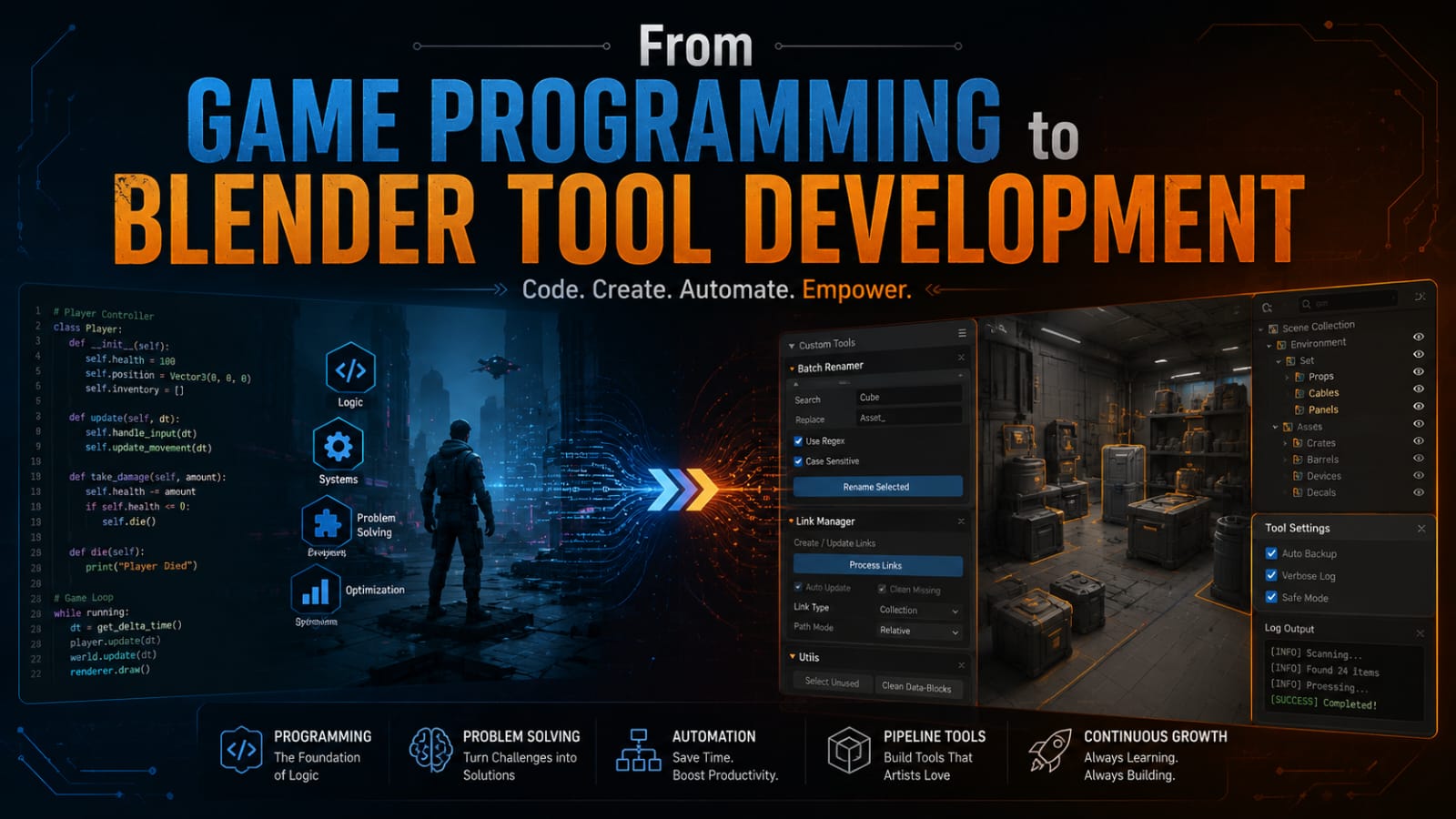
I didn’t start out as a 3D artist. My first love was game programming — writing C++ and C# for a diploma, building small games like Tic Tac Toe, a tile game, Space Shooter, and even a Subway Surfers-style runner. Those early projects taught me the fundamentals of code architecture and problem-solving that I still rely on today. But somewhere along the way, I found myself more drawn to the visual side of game development — the environments, the lighting, the worlds that code brings to life.
The Pivot to 3D
That curiosity pulled me into Blender, and I quickly realized that my programming background gave me a unique perspective. While most artists were clicking through menus, I was thinking about how to automate repetitive tasks with Python. While others moved vertices one by one, I was building Geometry Nodes setups to scatter entire forests. The technical approach to art became my signature, and it opened the door to feature film production.
My first film role was as a 3D Artist working on environments, lighting, and rendering. I was modeling, set dressing, and building layouts in Blender — the same tool I had started learning in my spare time. Later, I moved into groom binding and Alembic cache workflows with Unreal Engine integration, bridging the gap between DCC tools and real-time pipelines. Every role taught me something new about how production actually works at scale.
Why I Started Building Tools
The tools I build today — Texture Pipeline Studio and LinkFlow — were born from the same frustrations I experienced in those production environments. Texture Pipeline Studio came from hours spent manually hunting through folders for the right texture resolution, then rebuilding shader networks from scratch every time I wanted to switch from 8K to 2K for viewport performance. LinkFlow was conceived in the chaos of a multi-artist Blender pipeline where broken links and out-of-date references were costing hours every week.
I realized that my programming background wasn’t just a separate skill — it was the exact thing I needed to solve these problems. I could see both sides: what the artist needed and how the code could deliver it. That perspective is what makes my tools different. They’re not written by a pipeline TD who’s never textured a model, or an artist who’s never written a function. They come from someone who’s done both, in the same room, sometimes in the same day.
Lessons From the Film Floor
Working on feature films taught me the non-negotiable rules of production tools: they must work every time, fail gracefully, and be instantly understandable by artists who don’t read code. A tool that crashes on edge cases isn’t a tool — it’s a liability. A tool that requires reading a manual isn’t a time-saver — it’s another task on the artist’s to-do list. These principles guide every decision I make when building add-ons.
Another lesson: the best tools solve problems the artist didn’t know they had. When I built Texture Pipeline Studio’s LOD switching, I wasn’t solving a problem anyone had explicitly asked about. But every artist who hit Ctrl+S knowing they’d have to rebuild their shaders at a different resolution was silently hoping for exactly that feature. The art of tool building is identifying those silent frustrations and eliminating them.
Game Dev as a Creative Outlet
Outside of work, I continue making games — Lost Chroma in Unreal Engine 5 and The Last Outpost in Unity 6. These projects let me flex the creative muscles that don’t always get used in pipeline tool development. They’re also a constant reminder of why I got into this field in the first place: the joy of bringing something new into existence, whether it’s a character running through a forest or a Python script that saves an artist three hours.
Game development and tool development aren’t as different as they seem. Both involve building systems that need to be robust, responsive, and intuitive. Both require understanding how the user (or player) will interact with your creation. And both are incredibly satisfying when they click into place.
Looking Ahead
My road from game programming to Blender tool development has been anything but straight. But every twist — the C++ classes, the film sets, the frustrating pipeline bottlenecks — has led to where I am now: building tools that make artists’ lives better. I’m excited to keep going, to keep shipping, and to share the journey here on this blog.